BOGANCLOCH’ – THE LIFE OF A HIGHLAND HERMIT – A DOCUMENTARY BY BEN RIVERS


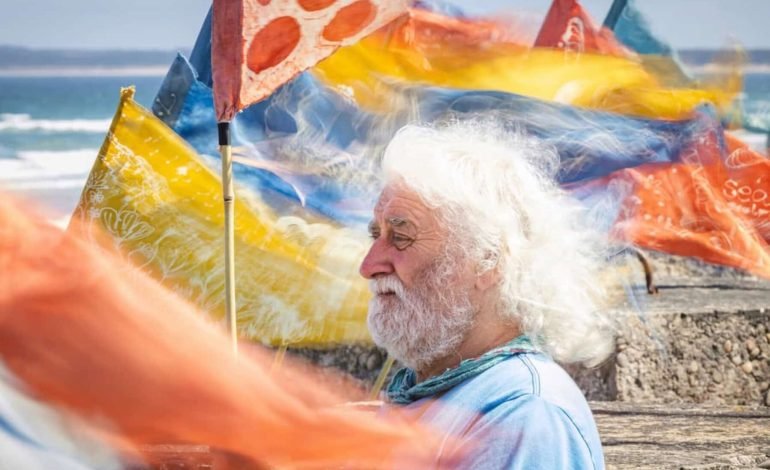
In ‘Bogancloch’ we observe the Scottish Highlands as a forest-filled Winterland. A wilderness occupied by a quirky, yet contented, white-bearded hermit named Jake Williams. Director Ben Rivers is often described by film reviewers as being an ‘Experimental Filmmaker’ – a term that will either deter or entice you. I’d venture that ‘Bogancloch’ will transfix anyone sitting inside a movie theatre. Just don’t eat a bucket of popcorn. Okay? It’ll disturb the reticence of this transcendental film. Otherwise? Everyone will turn around and go, “Shhh!”
FLASHBACK
In 1980 I met the late Colin Young, the brilliant founder Director of The National Film & Television School (NFTS), who, with a mischievous twinkle in his eye, barked, “If you want to make ‘Experimental Films’? Don’t come here!” Life, like experimental films, can be a subjective menu of choice: namely, pleasure, tedium, sadness and pain. The point? Well, life is just like going to watch a variety of movies. Isn’t it?
INFLUENCES
I’d always admired the work of the great British director Nic Roeg, who sat opposite me at my Final Board inquisition for the mighty NFTS. A decade before, Roeg’s Australian movie Walkabout (1971) may well have been deemed to be ‘experimental’. Did this mean Walkabout was unwatchable? Quite the contrary. The director-cameraman’s observations of the wildlife and of the elemental spirit of the outback keenly captured our collective gaze.
‘Bogancloch’ also reminded me of the work of the Cornish filmmaker Mark Jenkin, whose Enys Men (2022) had scenes of birdlife, foraging in lingering shots. Albeit a parallel in a very different film. Enys Men was a drama, not a documentary. ‘Bogancloch’ also parallels Mark Jenkin’s own method of shooting – not least by way of processing his own 16mm film to great visual effect in an otherwise digital age. Rivers, too, is possibly the processor of his own widescreen black-and-white ‘silver nitrate’ 16mm film stock. Patterning and bubbling sometimes appears on ‘Bogancloch’s’ images, adding to the visuals – notably when a wood-burning stove appears to generate swathes of acrid black smoke.
‘PINING FOR THE FJORDS’ LEADS TO ABERDEENSHIRE
In 2012 Ben Rivers told a BFI Southbank audience of his original intentions to seek out a Norwegian hermit who’d opted out of our modern metropolitan world by choosing, instead, a peaceful life in the wilderness. Unable to find such a person in Norway, Rivers stopped ‘Pining for The Fjords’ and flew home. He later heard of a bearded man living in the Clashindarroch Forest on the edge of the Cairngorms in Aberdeenshire. The path to ‘Bogancloch’ began there in 2006. Our hermit in question, Jake Williams, bears an uncanny resemblance to the white-bearded old man who only ever said “It’s” at the beginning of each episode of Monty Python’s Flying Circus (1969–1974).
JAKE WILLIAMS
In Ben Rivers’ short This Is My Land (2006) and his two subsequent features, Two Years At Sea (2011) and ‘Bogancloch’ (2024), Rivers stood behind his own locked-off camera to film the actions of his protagonist, Jake Williams. These lingering scenes unfold slowly in front of our very eyes. The only action is Jake Williams – the moving subject – seen within the static framing. We, the audience, are mere voyeurs into the life of a man who could’ve possibly worked in Harrods as Santa Claus or as a less frenetic version of Catweazle for yet another TV remake. But no. Williams chose to occasionally teach instead, otherwise opting for a solitary woodland existence amid his greenhouses, a shed, and two dilapidated bothies. He chooses, wisely, to sleep fully clothed inside his small 1960s snow-covered caravan.
Williams is seen happily murmuring to the trees, his cat, or singing an old show tune in his daily routine. This somehow, uncannily, mirrors a wider parallel to our post-Covid era – one that sees millions of us working from home. Here our lives, too, echo a world foretold by the influential Belgian filmmaker, the late Chantal Akerman. Her best film gauged the routines of domestic drudgery for women. She got there first. Don’t just take my word for it? The BFI’s Sight & Sound magazine voted Jeanne Dielman, 23 Quai du Commerce, 1080 Bruxelles (1975) as the greatest film ever made in a BFI Critics Poll (2022). A new print of Jeanne was issued by the BFI in February this year. So, as you can see, Akerman’s observations of lifestyle and routines remain influential. Now you can gauge why the BFI loves ‘Bogancloch’ too.
TRANQUILITY BASE IS NOT ON THE MOON. IT’S IN ‘BOGANCLOCH’
Williams’ own version of ‘Tranquility Base’ is also known as ‘Bogancloch’ – the ramshackle haven in the woods. A significant day away for Williams is when he teaches at an unnamed Highland school. We silently observe unspeaking, attentive teenagers. They appear to be gobsmacked when Williams twirls a Martini umbrella – all in order to explain astronomy. Cardboard planets and moons dangle from attached wires. Just as Williams is about to conclude, the school bell curtails matters. The class scarper. There is only silence. Williams momentarily addresses the empty classroom before realising – they’ve all gone.
The silence of this sequence reminded me, indirectly, of scenes in François Truffaut’s film The 400 Blows (1959). More specifically, however, Bill Forsyth’s second feature film, Gregory’s Girl (1981), springs to mind – especially in a scene where Chic Murray teaches a class where, similarly, the school bell interrupts him abruptly, leaving Murray murmuring.
The best scene in ‘Bogancloch’ shows Williams emptying plastic containers of water into a snow-filled enamel bath. He quickly undresses to climb in. A loud crackling sound is soon revealed to be that of burning wood. Yes – he’s installed a fire underneath his very own cast iron bath, percolating himself in an outdoor cauldron. The scene is silently filmed from above. Slowly, but imperceptibly, the camera moves higher and higher until Williams’ bath is but a mere dot in a Highland landscape.
‘EXPERIMENTAL FILMMAKING?’
Call it what you want. For me this is pure cinema. Simply one of the best films ever to come out of Scotland since the poetics of The Bill Douglas Trilogy, made some fifty years ago in both Edinburgh and in the nearby Victorian mining village of Newcraighall by Musselburgh.
‘Bogancloch’ is currently screening at Curzon Bloomsbury in The Bertha DocHouse. Catch it while you can.
To explore how filmmakers are shaping visual storytelling through analogue methods, this interview with director Mark Jenkin sheds light on a parallel artistic philosophy that resonates strongly with Bogancloch.
For more thoughtful takes on independent cinema, British film, and standout performances, explore our full range of Film Reviews on EyeOnLondon. We’d love to hear your thoughts in the comments – what’s the last film that stayed with you?
Follow us on:



Subscribe to our YouTube channel for the latest videos and updates!

We value your thoughts! Share your feedback and help us make EyeOnLondon even better!