COP31 Opens in Antalya as the World Heads for 2.8°C of Warming

Could a difference of just over a degree reshape the way we live? When world leaders gather in Antalya, Türkiye, for the COP31 climate summit from 9 to 20 November, they will do so knowing that the world remains on course for around 2.8°C of warming by the end of the century.
That is the projection from the UN Environment Programme’s Emissions Gap Report 2026, published last month, which concludes that overshooting the 1.5°C limit agreed in Paris is now effectively unavoidable. New research suggests that parts of the West Antarctic Ice Sheet may already be at, or beyond, the point at which large-scale ice loss becomes self-sustaining, findings recently explored on New Scientist’s podcast The World, the Universe and Us.
UN Secretary-General António Guterres put it bluntly in his message accompanying the report: “The emissions gap is now a leadership gap.”
Scientists increasingly see climate change not only as a matter of rising temperatures, but as a threat to the systems that support modern life, from farming and fresh water to trade and economic stability. Yet, it seems, the worst outcomes are still within our power to prevent.
How Hot Will the Planet Get?
In 2015, the Paris Agreement committed governments to keeping warming well below 2°C, while pursuing efforts to limit it to 1.5°C. We are already uncomfortably close to that lower limit: the World Meteorological Organization puts 2025 at around 1.43°C above the pre-industrial average, and 2024 briefly crossed 1.5°C. A single year above the line does not breach the Paris target, however, which is measured over the long term.
Under existing policies, UNEP projects warming of 2.8°C this century, still rising after 2100. If countries honour their current pledges, that falls to around 2.6°C, and delivering additional net-zero commitments would bring it to roughly 2.1°C. Every five years of emissions at today’s rate adds about 0.1°C to eventual peak warming.
A degree may sound modest, but global averages conceal far greater regional extremes, with land warming faster than the oceans, and every fraction of a degree raises the likelihood of extreme heat, drought and flooding.
Antarctica: Approaching the Point of No Return
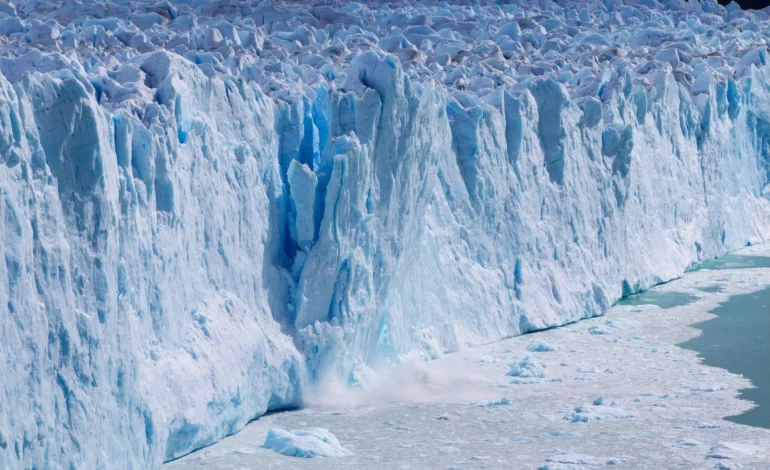
Some of the most unsettling findings come from the bottom of the planet. A study published in Nature Climate Change in February, led by Ricarda Winkelmann of the Potsdam Institute for Climate Impact Research and the Max Planck Institute of Geoanthropology, simulated 18 Antarctic drainage basins to map where each tips into long-term decline. Rather than a single tipping point, the team found a sequence of them, and warned that several West Antarctic basins, including Thwaites and Pine Island, home to the glacier nicknamed the ‘Doomsday Glacier’, may already be close to, or beyond, their thresholds at today’s warming of around 1.3°C.
The researchers estimate that around 40 per cent of the ice stored in West Antarctica may already be committed to long-term loss at today’s level of warming, while parts of East Antarctica could cross their own thresholds at 2 to 3°C. Once under way, that retreat may continue even if temperatures later fall.
“Crossing a tipping point doesn’t mean immediate collapse,” Winkelmann said in a statement released with the study, noting that large-scale ice loss in these regions unfolds over centuries rather than overnight, even where thresholds may already have been crossed.
Closer to home, the IPCC projects 44 to 76cm of global sea-level rise by 2100 under an intermediate-emissions scenario, relative to 1995 to 2014. For coastal cities such as London, New York, Mumbai and Shanghai, that means costlier flood defences, more frequent flooding and mounting pressure on infrastructure.
A World of Unreliable Harvests
One of the most immediate threats lies on our plates. A 2025 study in Nature, led by Andrew Hultgren, examined six staple crops across 12,658 agricultural regions, together representing around two-thirds of the world’s crop calories. For every additional degree of warming, annual production could fall by a staggering 550 trillion kilocalories, around 120 calories per person per day, or roughly a banana’s worth.
Adaptation, from hardier varieties to new planting dates and irrigation, would offset only about 23 per cent of projected losses by 2050 and 34 per cent by 2100 under high emissions. Surprisingly, some of the steepest declines were found not in poorer nations but in today’s breadbaskets, where farming is finely tuned to the current climate.
When harvests fail across several major growing regions at once, prices rise, trade is disrupted and vulnerable people go hungry. Britain, which imports a substantial share of its food, would not be insulated.
Solomon Hsiang, the study’s senior author and a professor at Stanford University, has described the scale of the losses in stark terms. Warming of 3°C, he said, would be “basically like everyone on the planet giving up breakfast.”
The Economic Cost
Heat saps productivity, floods destroy infrastructure and extreme weather disrupts manufacturing, transport and energy supplies. In a 2026 paper in The Quarterly Journal of Economics, economists Adrien Bilal and Diego Känzig estimated that an additional 1°C of global warming could reduce long-run world GDP by more than 20 per cent, against earlier estimates of just 1 to 3 per cent per degree. Their figure remains debated, but they argue that rising global temperatures drive extreme weather across many regions at once, something studies based on local temperatures tend to miss.
A separate 2026 study in Nature, led by Stanford economist Marshall Burke, found that the future costs of carbon dioxide already emitted are likely to be at least ten times greater than the damage it has caused so far.
For households, that could mean higher food and energy bills, rising insurance premiums and squeezed public finances, with some homes in flood or wildfire-prone areas becoming difficult to insure.
The Human Toll
Climate change does not automatically cause wars, but the IPCC identifies food insecurity, water scarcity, economic shocks and displacement as pathways through which it can aggravate existing tensions. Displacement is already vast: according to the Internal Displacement Monitoring Centre, disasters triggered around 45.8 million internal displacements in 2024, the highest figure since records began in 2008, although not all can be attributed to climate change. The evidence does not, however, support predictions of inevitable global conflict, and strong institutions and international cooperation remain decisive.
The effects on health stretch far beyond heatwave deaths. Rising temperatures increase the risk of heat exhaustion, cardiovascular strain and kidney injury, particularly among older people and outdoor workers, while flooding can contaminate drinking water and a changing climate can shift the range of infectious diseases. The World Health Organization has estimated around 250,000 additional deaths a year between 2030 and 2050 from just four causes: heat exposure in older people, diarrhoea, malaria and childhood undernutrition.
What COP31 Must Deliver
Scientists emphasise that 2.8°C is not inevitable; it is the consequence of continuing current policies. UNEP outlines a pathway on which warming peaks at around 1.7 to 1.8°C by mid-century before potentially returning to 1.5°C by 2100. Getting there would require unprecedented cuts in greenhouse gas emissions: 18 per cent by 2030, 45 per cent by 2035 and 69 per cent by 2040, compared with 2025 levels. Full delivery of countries’ current pledges would cut emissions by just 5 to 8 per cent by 2030.
Even cuts that deep may not be enough. UNEP’s lowest overshoot pathway also relies on removing around 320 billion tonnes of carbon dioxide from the atmosphere this century, roughly eight years of global emissions at 2024 levels, using technologies whose safety, cost and scale remain unproven. And some damage cannot be undone: extinct species cannot be restored, and destabilised ice sheets may keep shrinking for centuries.
A world that peaks at 1.8°C would still face serious and, in places, irreversible harm. One that reaches 2.8°C would expose far more people and ecosystems to dangerous conditions. That is the choice facing the negotiators in Antalya, and every fraction of a degree they manage to avoid will count.
EyeOnLondon will be following COP31 from Antalya through 20 November, watching specifically whether the summit’s final text narrows the gap between the 2.8°C current-policy path and UNEP’s 1.7 to 1.8°C pathway, or merely restates it.
Independent arts, culture, ideas and criticism, from London and beyond, at eye-on-london.com.
[Image Credit | SciTechDaily]
Follow us on:



Subscribe to our YouTube channel for the latest videos and updates!

We value your thoughts! Share your feedback and help us make EyeOnLondon even better!